Chuck Freudenberg
The Door into SummerChuck Freudenberg is a components assistant chief engineer at Hired Girl and one of the few people in Dan Davis’s new century who becomes both a trusted engineering colleague and a genuine friend. His technical candor helps Dan catch up with modern engineering; his respect for Dan’s inventions affirms the scale of Dan’s past influence; and, when Dan considers testing an experimental time-displacement device, Chuck’s careful warnings make friendship an argument for caution rather than a license to indulge a desperate hope.
Identity and Engineering Outlook
Dan describes Chuck as the only genuine engineer among Hired Girl’s technical staff, contrasting him with colleagues he regards as overeducated “slipstick mechanics.” Chuck shares Dan’s skepticism about the company’s chief engineer, McBee, whom he says would rather do things as his grandfather did than welcome new methods. The assessment is not merely a contest over credentials: Chuck’s own engineering judgment rests on practical curiosity and willingness to examine unfamiliar ideas.
Chuck’s account of Hired Girl’s corporate history is qualified rather than authoritative. He does not know all the details, but understands that a manufacturing company had rented the patents Dan originally owned, and that a tax-saving merger about twenty years earlier exchanged Hired Girl stock for stock in the manufacturer. The merged company then took the name of the firm Dan had founded. Chuck thinks McBee may have been hired around that time and may own a stake in the company, though he presents both points as uncertain.
Colleague, Mentor, and Friend
Chuck and Dan grow close through conversations over beer about engineering, the company’s needs, and the proper relation between invention and practical work. Chuck is fascinated by Dan’s experience as a Sleeper: he wants to know what the earlier world was like as remembered by someone who experienced it, not to treat Dan as a freak. Dan has encountered other people whose interest in Sleepers makes him uncomfortable, so Chuck’s curiosity stands out as unusually healthy and humane.
That exchange of knowledge runs both ways. Chuck criticizes Dan’s new ideas when they prove to be old news by the standards of 2001, and Dan accepts the correction. Under Chuck’s friendly guidance, he becomes a modern engineer quickly. Chuck is therefore more than a source of technical facts: he helps turn the long gap in Dan’s life into a learnable difference, one that can be crossed through conversation, professional tools, and shared work.
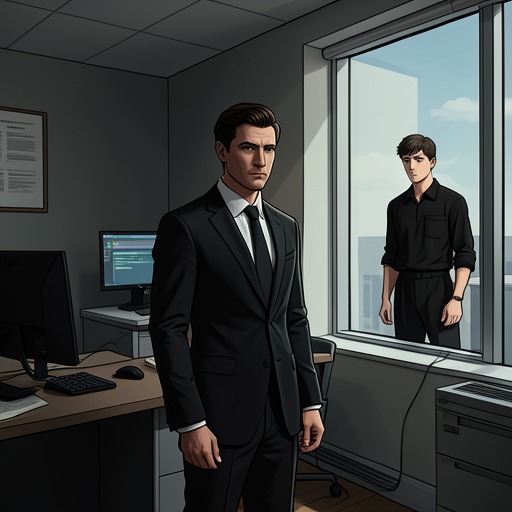
One evening, when a scrubwoman-type Hired Girl automaton silently rolls away after finding Dan still alone in his office, Chuck appears at the door and tells him to finish sleeping at home. Dan responds by proposing a barrel of beer and two straws. Their evening stretches from drinks to food and more drinks, with conversation continuing in booths at a place where the hush linings keep other noise out. The relaxed setting gives way to serious appraisal when Dan shows Chuck patent records: Chuck praises the Eager Beaver prototype, then studies Dan’s drafting-machine patents and says Dan may have influenced the state of the art more than Edison did in his period. The moment joins affection to professional judgment; Chuck’s pride in Dan is expressed through recognition of the actual work.
The Patent and the Question of Identity
Chuck’s friendship matters especially when Dan discovers a patent filed under the initials and surname “D. B. Davis,” matching his own. Dan worries over what the coincidence might mean. Chuck does not dismiss the evidence, but separates what it establishes from what it cannot: two engineers with similar talents might independently work on similar things and share initials and a last name. The coincidence is unlikely, he agrees, yet probability describes how unlikely an event is, not whether it can happen.
Chuck’s response preserves their friendship without offering false certainty. He prefers the coincidence explanation to the thought that his beer companion has lost his grip, and recommends identifying the patent-holder’s first name before Dan spends money on a psychiatrist. The name might turn out to be Dexter or Dorothy; even Daniel would not settle the matter if the middle name and identifying details differed. Chuck’s humor lightens the exchange, but his reasoning gives Dan a practical next step while refusing to treat a striking resemblance as proof.
Twitchell’s Experiment and the Warning Against Risk
Chuck later tells Dan, with the reminder that Dan’s “Alpha” status makes the disclosure permissible, that the time-travel phenomenon is real but not practically usable. It was classified because it arose as a by-product of NullGrav, not because it offered a workable means of travel. The bugs were never solved, Chuck says, and he sees no prospect that they could be; even research would gain no practical value from the effect. His account thus sharply distinguishes the existence of an extraordinary phenomenon from the reliability required to act on it.
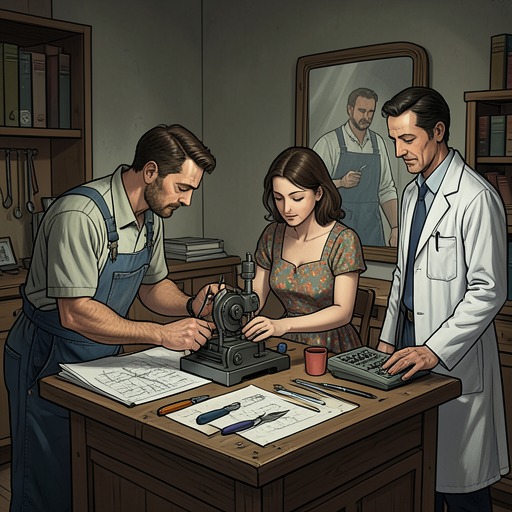
Chuck traces his knowledge to his senior year at the University of Colorado at Boulder, where he earned money as a laboratory assistant. He first worked in a cryogenics lab, then was reassigned under Professor Hubert Twitchell to a new mountain physics laboratory supported by a defense contract concerning Edinburgh field theory. Twitchell, a physicist who had narrowly missed a Nobel Prize and was bitter about it, wondered whether polarization around another axis could reverse a gravitational field rather than merely level it off. After feeding the results of his experiment into a computer, he grew excited, marked two silver dollars, and placed them in a test cage. When he pressed the solenoid button, the coins disappeared. Chuck was paid by the hour and never saw the calculations that had prompted Twitchell’s reaction; his account is that of a lab assistant recalling what he witnessed, not a claim to have understood the entire experiment.
When Dan proposes using the device to investigate the mystery troubling him and then returning by Long Sleep, Chuck lays out concrete risks instead of simply forbidding him. The device might send Dan forward rather than back. Even if it sent him into the past, it might miss 1970 by a considerable margin, because Chuck doubts Twitchell had calibrated it. The laboratory itself had been built in 1980 among pine trees: arriving ten years earlier could mean materializing where the building did not yet exist, inside a western yellow pine, with potentially catastrophic consequences. Chuck also points out that Dan cannot know whether he would return at all. The warnings turn an exciting possibility into a chain of unknowns, and show the same engineerly discipline that earlier helped Dan distinguish a new invention from an obsolete one.
Narrative Role and Significance
Chuck’s function in Dan’s story is to make technical judgment inseparable from personal loyalty. He welcomes Dan’s memories without reducing him to the oddity of being a Sleeper, helps him learn a transformed profession, and celebrates the inventions that reveal the reach of his earlier work. Yet when Dan’s private uncertainty makes time travel seem attractive, Chuck does not let affection become credulity. He acknowledges the phenomenon while insisting on the gap between a demonstrated effect and a dependable method.
That balance gives Chuck’s scenes two related kinds of authority. In the patent conversation, he keeps an improbable coincidence from hardening prematurely into a conclusion; in the account of Twitchell’s apparatus, he makes physical and temporal uncertainty impossible to ignore. He is not presented as omniscient: he lacks the full experimental record, admits where he was only a paid assistant, and speaks cautiously about the company’s history. His usefulness instead lies in calibrated judgment—the ability to distinguish what he knows, what he suspects, and what Dan would be risking if he acted as though uncertainty were certainty.